
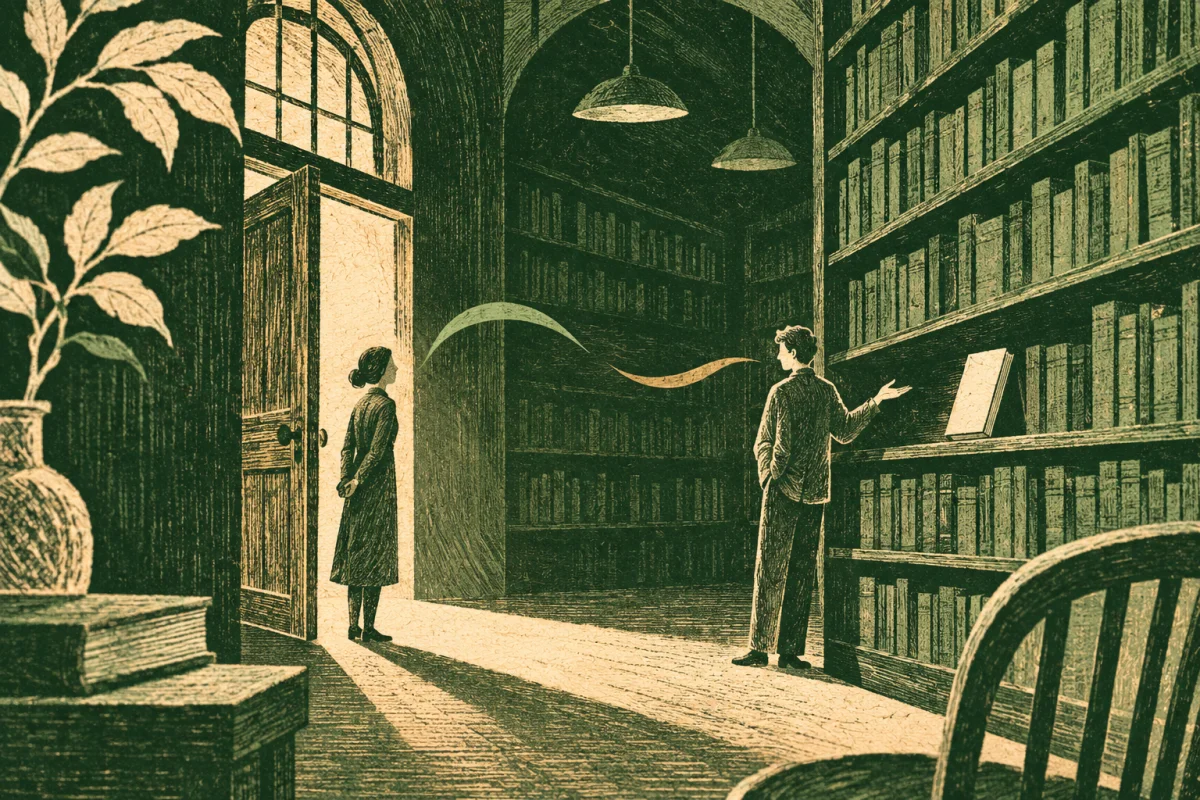
Two colleagues have different reasons to stay or leave
“Why are the lights still on?” can be a simple question, or a nudge from someone ready to go home. To make it part of a conversation, we need to know why the other person has left them on.
This original fictional scene takes place as a library closes. Mia wants to catch the last bus. Noah knows a reader is still upstairs: she is moving tomorrow and wants to find a book her father donated. The colleagues know different things and have different immediate aims.
Mia: Why are the lights still on? We close at eight.
Noah: Someone's upstairs, looking for a book.
Mia: Can't she come tomorrow? I'll miss the last bus.
Noah: She's moving tomorrow. Her dad donated it.
Mia: Which shelf?
Noah: Third row, by the window. I'll hold the door.
Mia never announces, “I understand, and I have decided to help.” Asking “Which shelf?” changes the direction of the scene. The colleague who wanted to leave starts looking for the book. Noah answers the new question and offers to hold the door.
The same six recordings, with two ways of handing over
Both edits use exactly the same six speech clips. The roles, words, delivery and clip levels stay fixed. The first edit adds equal silence at every handover. The second uses quicker early replies and more space around the reason for staying. Listen especially between “Her dad donated it” and “Which shelf?”
Evenly spaced edit
An extra 0.60 seconds between every turn.
Scene-shaped pauses
Quicker early replies, with more space around the reason for staying.
These are two editorial choices. The second aims to give a character time to reconsider; whether that works depends on the actual performance. It is not a rule for every conversation, and a slower exchange does not automatically carry more feeling.
Write what each line asks the other person to do
Mia starts by nudging Noah to close up, then explains the cost of waiting: missing the bus. Noah first says someone is still upstairs, then reveals why the book matters. Because he does not deliver all the background at once, Mia has a reason to ask another question.
| Line | What the speaker is doing | What the reply needs to address |
|---|---|---|
| “We close at eight.” | Pressing a colleague to finish. | Why Noah has not closed up. |
| “I'll miss the last bus.” | Making the cost of staying explicit. | Whether to explain the reader’s reason. |
| “Her dad donated it.” | Adding something Mia did not know. | Whether to leave or help. |
| “Which shelf?” | Joining the search. | Where to look, rather than more explanation. |
Try marking an action beside each line: prompting, clarifying, testing, refusing or asking for help. If several lines only supply background for the audience, two alternating voices can still sound like a shared announcement.
Answer the previous line before filling in the whole world
Noah could begin by explaining which floor the library occupies, its opening hours and how borrowing works. Those details might be accurate, but they would not answer why Mia cannot leave. “Someone’s upstairs” addresses the immediate question; the rest arrives when the exchange needs it.
Characters can omit what they already share. “Which shelf?” remains clear because the search for a book is established. If the scene also involved missing keys and a missing person, naming the book again could restore the connection.
A short line earns its place by changing the action. Cutting every sentence down to a few words can make characters trade riddles. A listener still needs to know what a reply answers and why the next person responds that way.
Place silence where a character has a decision to make
The early handovers are familiar questions and replies between colleagues; a quicker exchange is one option. After the bus is mentioned, Noah is about to share the reader’s personal reason for staying. A little more space can suggest care in choosing to explain. After the father’s book is mentioned, another pause can hold Mia’s hesitation before she asks where to look.
| Handover | Extra silence: even edit | Extra silence: scene edit |
|---|---|---|
| Line1 → line 2 | 0.60s | 0.18s |
| Line2 → line 3 | 0.60s | 0.18s |
| Line3 → line 4 | 0.60s | 0.70s |
| Line4 → line 5 | 0.60s | 1.15s |
| Line5 → line 6 | 0.60s | 0.20s |
These are the silent intervals inserted during editing. Each clip retains a little space around its speech, so the numbers do not describe the entire perceived pause. They make this example reproducible, not universal. If a gap sounds like a player waiting to load, it may be too long; if the reply arrives before the thought has landed, try allowing more room.
Make the roles distinct and keep them in the same room
This English version assigns Aiden and Ryan to the two roles. Different voices help a listener follow the speakers, while wording and delivery establish their relationship. Familiar colleagues do not need to address each other by name at every turn. A quiet conversation at closing time also has little reason to sound like a public announcement.
Audition adjacent lines together, then play the whole scene. A voice can fit a character in isolation and still sit awkwardly beside the other performer. A large mismatch in level or apparent distance may make the characters seem to occupy different rooms.
Both edits reuse the same recordings with a fixed gain per role. Adjusting the pauses did not also replace a voice or performance, so attention can stay on the handovers. For identity across lines, continue with voice identity and performance.
Change one audible relationship at a time
For another pass at this scene, hide the role labels and listen for who is speaking and what each person wants. Then check whether “Which shelf?” feels like a response to the reason just revealed. If the delivery never suggests reconsideration, extra silence alone may not solve it; the line or performance may need another pass.
Separate those decisions. Revise a reply that does not connect. Adjust a handover that leaves too little time to take something in. Revisit casting when the roles become hard to follow. Keep the previous edit and compare at similar loudness. The two examples here change only the handovers.
The scene is assembled as sequential turns, with no overlapping speech, ambience or music. Interruptions, movement and room perspective would introduce other production decisions. This example does not demonstrate those effects.
Sources and production notes
The English role sources were generated through Sonano’s local engine on November 4, 2026, using Qwen3-TTS CustomVoice 1.7B 8bit (mlx-community/Qwen3-TTS-12Hz-1.7B-CustomVoice-8bit). English presets are Aiden / Ryan; The Chinese version uses the saved library voices “青春女声” and “自然男声” with Qwen3-TTS Base 0.6B 8bit (mlx-community/Qwen3-TTS-12Hz-0.6B-Base-8bit). Speed is 1.0, with other sampling defaults. Each role uses its first complete result; job records confirm a single unsegmented generation. The three turns were cut in word-free gaps and arranged in alternating order.
One fixed level adjustment was applied per continuous role recording, leaving peak headroom. Within each language, the six speech PCM clips are identical between edits; only the inserted silence in the table changes. Files are MP3, with no speed or pitch changes, compressor, limiter or background music. English edits run about 17–18 seconds; Chinese edits about 21 seconds.
Transcription checks the words; decoding and file comparisons check delivery of the assets. None replaces a listener’s judgment of the conversation or establishes a model ranking. For preparing spoken text, read turning written text into a script for listening.